Introduction
In recent years, prefabricated E-houses — also known as electrical houses, power control centers, or modular substations — have played an increasingly important role in modern industrial and infrastructure projects. Compared with traditional concrete substations and electrical rooms, E-houses offer faster deployment, better mobility, reduced on-site construction work, and a high level of integration for power distribution and automation systems.
As global industries continue to move toward digitalization, renewable energy, electrification, and smart infrastructure, the applications and technical standards for E-houses are evolving rapidly. From mining and oil & gas fields to data centers, utilities, ports, and renewable power plants, E-houses are becoming a strategic solution for reliable, scalable, and intelligent power supply systems.
This article explores the future development trends of E-houses, analyzing technology evolution, engineering design concepts, industry drivers, and application scenarios — and what these changes mean for end users, EPC contractors, and project developers.
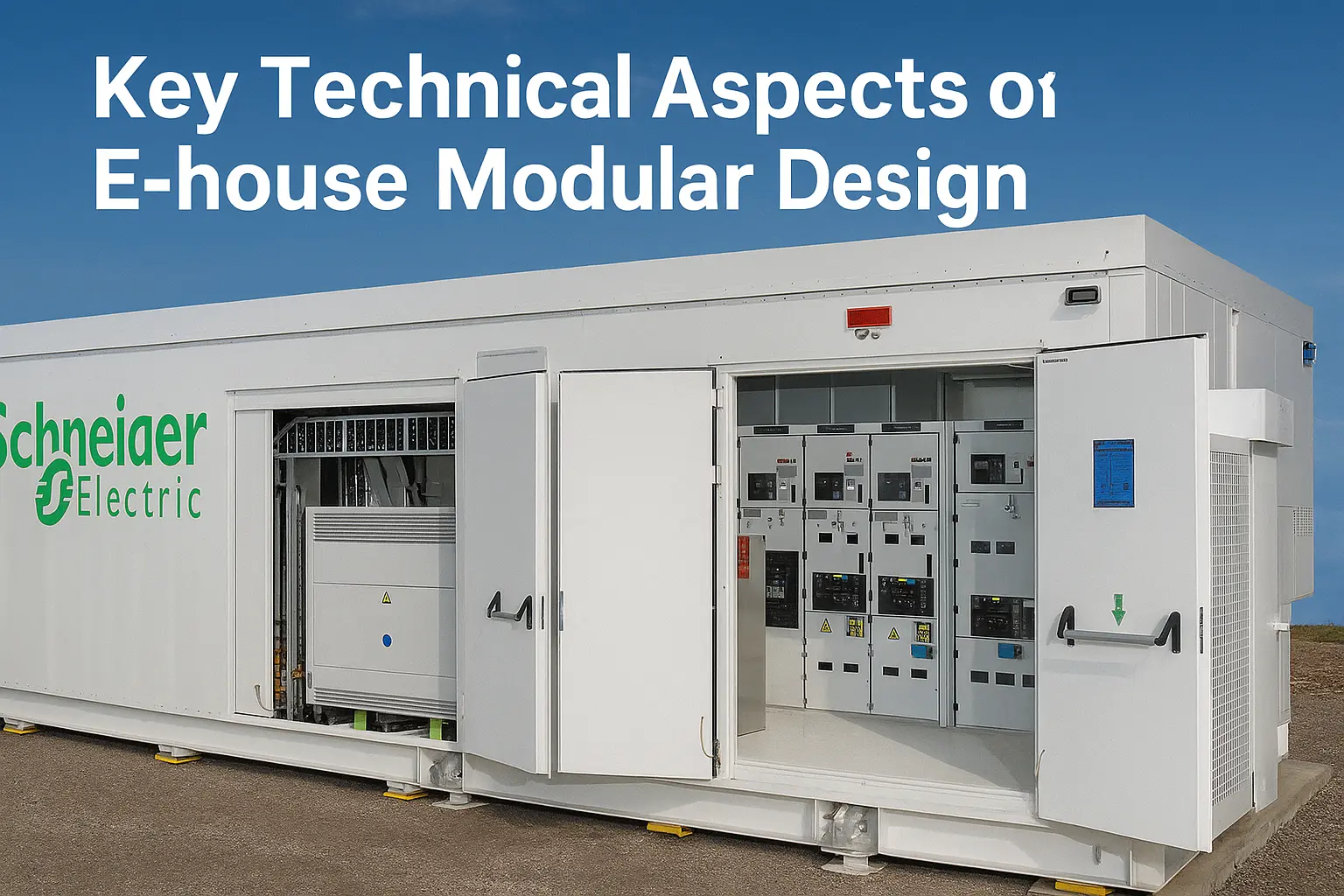
What is an E-house?
An E-house is a modular prefabricated building that integrates electrical and automation equipment inside a factory-assembled enclosure. It typically includes:
-
Medium-voltage switchgear
-
Low-voltage switchgear and MCC
-
Protection relays and automation systems
-
SCADA, communication, and monitoring devices
-
Power transformers or UPS (depending on configuration)
-
HVAC, fire protection, lighting, and auxiliary systems
Instead of building a concrete electrical room on site, the entire system is designed, assembled, wired, and tested in a factory. The completed module is then shipped to the project site as a plug-and-play power supply solution.
Key Advantages of E-house Solutions
-
Shorter construction and commissioning cycles
-
Reduced civil engineering work
-
Better quality control through factory assembly
-
Modular and scalable layout
-
Easier relocation and expansion
-
Lower overall lifetime costs
-
Standardized design and repeatable project models
With growing pressure on project timelines and investment efficiency, these benefits will continue to drive global demand for E-house systems.
Trend 1: Modularization and Standardized Engineering
One of the most significant future trends in E-house development is the shift toward modular and standardized engineering.
Traditional E-houses were often customized for each project, resulting in lengthy design cycles, limited interchangeability, and complex logistics. Today, more manufacturers and EPC partners are moving toward:
-
Standardized E-house platform designs
-
Modular structural dimensions
-
Repeatable electrical configurations
-
Flexible expansion interfaces
This approach enables:
-
Faster engineering approval
-
Reduced material and fabrication cost
-
Easier international transportation
-
Simplified on-site installation
-
Consistency in performance and reliability
Platform-based E-house Design
Future E-house systems will increasingly follow a platform-based design model, similar to modular product architecture in industrial manufacturing.
Typical platform modules may include:
-
MV switchgear compartment module
-
LV switchboard / MCC module
-
Automation & control module
-
Battery / UPS module
-
Renewable integration module
-
Auxiliary support module
Instead of redesigning from scratch, engineers can configure solutions using predefined module combinations. This helps accelerate delivery — especially in large-scale industrial and utility projects.
Trend 2: Digitalization and Smart Monitoring
As industries adopt smart grid technologies and digital asset management, E-houses are evolving into intelligent energy management nodes rather than simple power distribution units.
Future E-house designs will feature enhanced digital capabilities such as:
-
Online condition monitoring
-
IoT-enabled smart sensors
-
Cloud-connected SCADA platforms
-
Asset health diagnostics
-
Remote operation & maintenance tools
-
Predictive maintenance analytics
From Passive Equipment to Active Data Hubs
Smart E-houses will become:
Data-driven infrastructure assets that support operational decision-making and lifecycle optimization.
Examples include:
-
Real-time temperature, humidity, and vibration monitoring
-
Electrical parameter analytics and fault recording
-
Switchgear breaker health prediction
-
Remote firmware upgrades
-
Cyber-secure communication networks
This trend is particularly valuable for:
-
Remote mining and oil fields
-
Offshore facilities
-
Renewable power stations
-
Harsh environmental locations
where on-site maintenance resources are limited.
Trend 3: Integration with Renewable Energy and Microgrids
Global energy systems are transitioning toward renewable power and distributed energy resources. As a result, future E-houses will increasingly support:
-
Solar and wind farm substations
-
Battery energy storage systems (BESS)
-
Hybrid microgrid power systems
-
Grid-tie and island operation modes
This development requires:
-
Advanced protection & coordination schemes
-
Higher levels of automation
-
Energy management interfaces
-
Bidirectional power flow capability
E-house as the Core of Microgrid Infrastructure
In many remote regions, off-grid or weak-grid areas rely on:
-
Diesel generators
-
PV arrays
-
Wind turbines
-
Battery storage systems
E-houses can function as the:
-
Central control room
-
Power conversion center
-
Protection and switching hub
enabling reliable and efficient microgrid operation.
As global sustainability policies accelerate, renewable-ready E-house solutions will become a mainstream engineering trend.
Trend 4: Higher Safety, Reliability, and Compliance Standards
Future development of E-houses will also focus on enhanced safety, durability, and international compliance.
Engineering designs are expected to prioritize:
-
Fire and arc-flash risk mitigation
-
Improved structural strength
-
Higher ingress protection ratings
-
Seismic and wind-load resistance
-
Enhanced personal safety measures
Depending on application regions, E-house systems may involve:
-
IEC and IEEE standards
-
UL / CSA certification for North America
-
Utility and grid-specific requirements
-
Special industrial safety norms
Application-Specific Engineering Adaptations
Typical scenarios include:
-
Desert high-temperature environments
-
Offshore and coastal salt-spray conditions
-
Cold-climate operation
-
Chemical or hazardous areas
Future E-house solutions will adopt:
-
Specialized insulation materials
-
Corrosion-resistant coatings
-
Reinforced structural modules
-
Environmental-grade ventilation and sealing
This evolution ensures long-term performance stability and reduces lifecycle risk for project owners.
Trend 5: Faster Deployment and Project Delivery Models
Project development cycles are becoming shorter — especially in:
-
Data center construction
-
Renewable power projects
-
Emergency expansion facilities
-
Temporary industrial sites
E-houses naturally align with these market needs.
Future project models will increasingly adopt:
-
EPC + Prefabricated Modular Delivery
-
Off-site factory assembly and FAT testing
-
Plug-and-play on-site integration
This reduces:
-
On-site construction time
-
Labor and logistics constraints
-
Commissioning complexity
-
Project cost uncertainty
Factory-Integrated System Testing
A key trend is the expansion of:
Full system functional testing before shipment.
This includes:
-
Control logic verification
-
Protection relay testing
-
Communication system integration
-
Power system interlocking checks
By verifying performance in the factory, project risk is significantly reduced, and on-site commissioning becomes smoother and safer.
Trend 6: Lifecycle Service and Remote Technical Support
As E-house systems become more intelligent, service models are also evolving toward long-term lifecycle partnerships rather than one-time equipment delivery.
Future service offerings are expected to include:
-
Remote performance monitoring
-
Lifecycle health assessment reports
-
Spare parts and component upgrade plans
-
Remote troubleshooting assistance
-
Periodic technical inspection services
This approach helps customers:
-
Extend equipment lifespan
-
Reduce unplanned downtime
-
Optimize operating costs
-
Improve asset availability
For global project owners and EPC partners, strong lifecycle service capability will become a key factor when selecting E-house suppliers.
Trend 7: Expansion into More Industrial Application Scenarios
With growing engineering maturity and technology innovation, E-house applications will continue to expand across industries such as:
-
Mining and minerals processing
-
Oil & gas fields
-
Ports and logistics hubs
-
Data centers
-
Renewable power plants
-
Rail and transportation
-
Utilities and smart grids
-
Large industrial facilities
Each sector presents different functional priorities — for example:
-
Mining projects value mobility and ruggedness
-
Data centers require high reliability and fast deployment
-
Renewable power plants emphasize scalability and system integration
Future E-house solutions will become increasingly application-oriented, offering optimized configurations tailored to each industry’s operating characteristics.
Sustainable Design and Environmental Considerations
Sustainability is another major direction shaping the future of E-house systems.
Manufacturers and project developers are paying closer attention to:
-
Energy-efficient HVAC systems
-
Environmentally friendly materials
-
Reduced construction waste
-
Reusable modular structures
-
Lower carbon footprint across the lifecycle
Because E-houses are prefabricated, they naturally reduce:
-
On-site environmental disturbance
-
Heavy civil construction activity
-
Waste material handling
In the long term, sustainable engineering will strengthen the competitiveness of E-house solutions in global infrastructure development.
The Strategic Role of E-house in Future Power Infrastructure
Looking ahead, E-houses will not only serve as electrical equipment shelters, but as:
-
Smart power system integration platforms
-
Digital infrastructure control nodes
-
Scalable and mobile energy centers
-
Strategic components of modern industrial development
They will continue to support:
-
Fast-growing emerging markets
-
Smart manufacturing and industrial automation
-
Renewable and distributed energy systems
-
Global infrastructure modernization
For project developers, EPC contractors, and end users, selecting the right E-house partner — with strong design, manufacturing, testing, and service capabilities — will be essential to project reliability and long-term operational value.