The 38 kV switchgear has a power frequency withstand voltage of 80 kV and a lightning impulse withstand voltage of 150 kV. For metal shutters, isolation break voltage tests are not required; for non-metallic shutters, the isolation break withstand voltage is 1.1 times the standard value. The primary contact box of the circuit breaker compartment is equipped with a 600 V through-type current transformer. TOC and MOC are installed on the circuit breaker compartment without using grounding switches, resulting in a simplified rear section containing only main busbars and connection copper bars for incoming and outgoing lines.
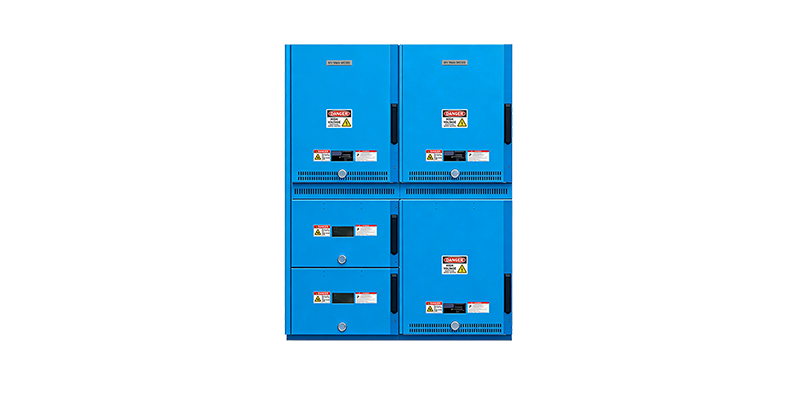 Alternatively, it can be configured as a single-tier circuit breaker trolley combined with a single-tier voltage transformer compartment. For power transformers (CPT), a separate switchgear unit is typically required. A fuse trolley is installed in the front compartment, while the CPT is fixedly mounted at the back of the cabinet.
The voltage transformer trolley is placed above the circuit breaker trolley compartment and connected to the busbar via cable or copper bar. The voltage transformer compartment includes shutters and a trolley-in/trolley-out mechanism. The voltage transformer trolley features mechanical interlocking: the trolley can only be pushed in or pulled out when the secondary circuit miniature circuit breaker is open. Additionally, during trolley withdrawal, a grounding copper bar automatically connects to the fuse, allowing residual charge from the voltage transformer to be safely discharged.
Instrumentation and indicator lights are mounted on the door panel of the circuit breaker compartment. The front unit depth of the circuit breaker compartment is 12 inches, meaning that even when the circuit breaker is in the open position, there remains 300 mm of space in front. Secondary circuits such as terminals and control switches can be installed on both sides and at the top and bottom, arranged integrally with the circuit breaker. Current transformers, auxiliary switches for trolley position, and auxiliary switches for circuit breaker open/close positions are all installed within this compartment, enabling local control and protection.
For power transformers, a fuse trolley is also required and installed in the front compartment. Due to high voltage levels and large insulation clearance requirements, the entire cabinet functions as a dedicated power transformer cabinet. As a device providing operating power, it must be located on the incoming line side. Therefore, power is supplied via cable from the incoming line cabinet to an adjacent cabinet. The lower terminal of the fuse trolley connects to the upper terminal, which leads to the fixedly mounted CPT at the back of the cabinet.
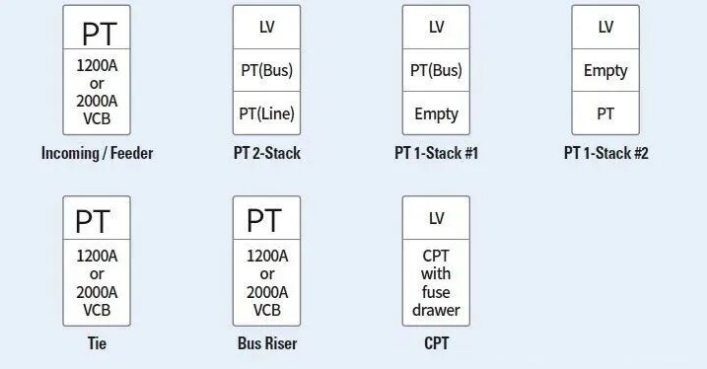 A typical layout is shown in the figure above. The upper compartment of the circuit breaker may serve as a low-voltage compartment or a voltage transformer trolley compartment (line-side or bus-side). The circuit breaker rated currents are 1200/2000/3000 A, with breaking capacities of 31.5/40 kA.
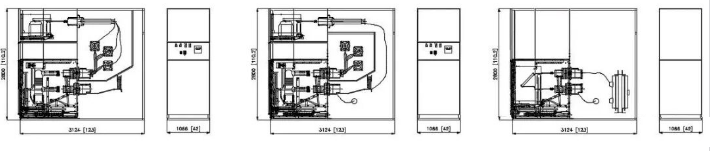 This compact and miniaturized 38 kV circuit breaker compartment features an upper voltage transformer compartment, with a 500 mm high instrument room optionally reserved in the middle—eliminating the need to install instruments on the door of the circuit breaker trolley compartment. This U.S.-standard outdoor switchgear is not simply an indoor switchgear placed inside a prefabricated enclosure; rather, the switchgear itself is designed for outdoor use, meeting requirements for rain protection, ice and snow resistance, radiation shielding, and corrosion resistance.
Outdoor switchgear has the same width as indoor units but increased depth and height. Compared to bulky outdoor enclosures, it is smaller in size and lighter in weight, enabling on-site assembly and convenient transportation. Individual cabinets are transported to site and assembled together, simultaneously installing protective components. Prefabricated modular parts allow simple and efficient assembly.
Whether equipped with or without an operation corridor, outdoor switchgear can be transported in sections and quickly assembled on-site. The main body width remains unchanged, while additional depth provides extra access channels. Lighting and other auxiliary facilities feature pre-fabricated plug-in structures for rapid installation.
The voltage transformer trolley is placed above the circuit breaker trolley compartment and connected to the busbar via cable or copper bar. The voltage transformer compartment includes shutters and a trolley-in/trolley-out mechanism. The voltage transformer trolley features mechanical interlocking: the trolley can only be pushed in or pulled out when the secondary circuit miniature circuit breaker is open. Additionally, during trolley withdrawal, a grounding copper bar automatically connects to the fuse, allowing residual charge from the voltage transformer to be safely discharged.
Instrumentation and indicator lights are mounted on the door panel of the circuit breaker compartment. The front unit depth of the circuit breaker compartment is 12 inches, meaning that even when the circuit breaker is in the open position, there remains 300 mm of space in front. Secondary circuits such as terminals and control switches can be installed on both sides and at the top and bottom, arranged integrally with the circuit breaker. Current transformers, auxiliary switches for trolley position, and auxiliary switches for circuit breaker open/close positions are all installed within this compartment, enabling local control and protection.
Outdoor switchgear has the same width as indoor units but increased depth and height. Compared to bulky outdoor enclosures, it is smaller in size and lighter in weight, enabling on-site assembly and convenient transportation. Individual cabinets are transported to site and assembled together, simultaneously installing protective components. Prefabricated modular parts allow simple and efficient assembly.
Whether equipped with or without an operation corridor, outdoor switchgear can be transported in sections and quickly assembled on-site. The main body width remains unchanged, while additional depth provides extra access channels. Lighting and other auxiliary facilities feature pre-fabricated plug-in structures for rapid installation.